The Evolution of Holographic Technology: From Visual Authentication to Advanced Optical Security

For many people, holograms are the reflective security features seen on packaging, certificates, identity documents, and branded products, certificates, identification documents, and branded items. However, while such reflective pictures have been considered signs of authenticity through the years, modern holographic technology has evolved into a sophisticated discipline combining optical science, precision engineering, and multi-layered authentication that utilises science and precision engineering, as well as multiple levels of validation. Holograms have come to represent one of the most sophisticated forms of optical security today.
In a world full of counterfeit goods posing as authentic products, firms and organisations have begun turning towards security options that cannot be replicated and can easily be verified. Modern holographic technology has become a critical component of brand protection strategies, as it provides much more than merely visual appeal. From three-dimensional visual effects to covert features and microtext, today's hologram technology acts as an effective means of authentication.
Holograms: From Visual Appeal to Advanced Authentication
Early commercial holograms were primarily introduced as visible authentication features that helped distinguish genuine products from counterfeit ones and ensured that the items could be identified visually. Since the image of the hologram was special, it could not be reproduced using standard printing technologies, which provided the additional protection of companies' brands.
However, with advances in technology, counterfeiters started to learn new techniques, and many conventional holograms no longer provided the level of protection required against increasingly sophisticated counterfeiting techniques. This was one of the reasons for the development of advanced holograms.
Nowadays, holograms serve as anti-forgery devices, and the purpose of their use is not to make the items look beautiful but to make sure that they cannot be forged in any way.
The Basics of Modern Holograms – The Light-Manipulation Technology Behind It
Modern holograms are based on advanced light-manipulation principles. Contrary to traditional printing methods, which make use of ink and pigments, modern holograms utilise microscopic surface structures to manipulate light.
Due to their small size, these elements are not visible to the human eye and they are designed in such a way that light interacts with them to produce various optical effects such as depth perception, colour shifts, kinetic movement, and image transitions, three-dimensional images, colour shifts, and motion effects.
Creating such optical effects involves special equipment and technology. All the holographic elements are created with great precision and expertise and require the use of proprietary technologies to replicate.
This combination of optical science and precision engineering enables the creation of sophisticated security holograms.
Emergence of 3-D Authentication Elements
The creation of realistic three-dimensional images is one of the most distinct features of holography in the contemporary era. Unlike the printed pictures, these images create the perception of depth, movement, and spatial separation.
Three-dimensional elements add a dual function to the hologram. First, they improve the visibility of the picture, and second, they increase its security level. In contrast to traditional printing methods, this type of picture formation is based on complicated optical arrangements, which makes accurate replication significantly more challenging.
High-end holograms can contain several layers of pictures so that each element of an image appears in a new viewing position. Thus, such an image becomes recognisable and hard to reproduce by counterfeiters.
Hidden Text: Security Beneath the Surface of the Visible
One of the most effective security features in modern holography is the integration of covert text elements. Contrary to the visible brandings, the hidden text can only be perceived upon application of certain parameters and magnifications. This technology offers another degree of security, which can be checked only by specialists and remains difficult for counterfeiters to detect and replicate.
As a rule, hidden text technologies find their application in cases when increased security measures are needed, namely in packaging, official papers, identification systems, and branded products.
Using this technology, the manufacturers manage to incorporate security elements in the structure of the hologram, which cannot be copied.
Micro-Text and Nano-Level Precision
As counterfeiting methods become more sophisticated, authentication technologies continue to evolve by becoming highly precise.
An example of such adaptation is provided by micro-text technology. Micro-text includes extremely small text, symbols, or patterns that can be viewed only through magnification. Despite being small in size, they are highly clear, readable, and an integral part of the hologram design.
To achieve this level of clarity and readability, an extremely high level of specialisation and precision in manufacturing microtexts is needed. This means that any mistake in production will result in the failure of this feature.
Furthermore, some holograms incorporate nano-scale structures that provide additional layers of authentication to add additional levels of verification.
Why It Is Difficult For Modern Counterfeiters To Imitate Holograms
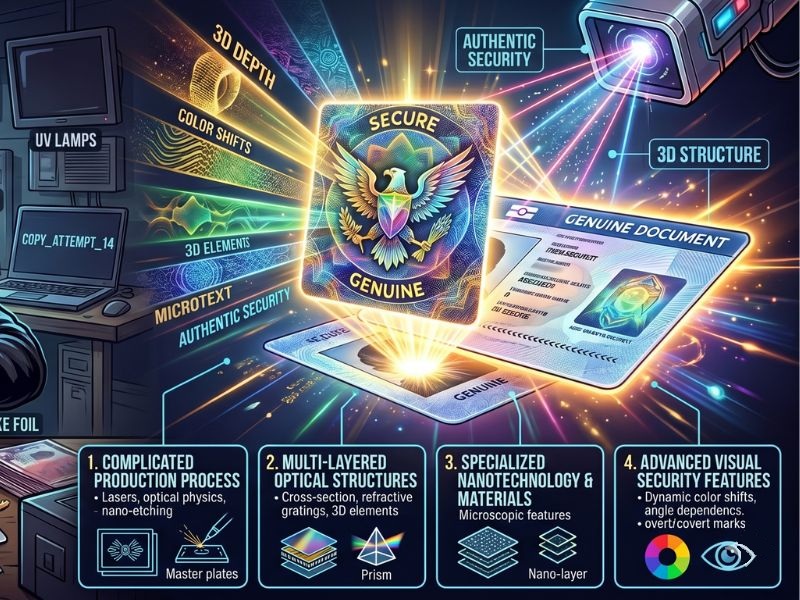
Modern counterfeiters can take advantage of advanced technologies when reproducing packaging and branding materials. High-resolution scanning and printing technologies as well as computer graphics allow for easy imitation of conventional images.
Nevertheless, the imitation of holographic security elements proves to be a particularly complicated task.
The primary challenge lies in the combination of optical design, micro-structuring, specialised materials, and proprietary origination processes.
These include not only optical techniques but also micro-structuring, special materials, advanced manufacturing technologies, and design elements of security systems.
The imitation of a hologram involves much more than mere image replication. The reproduction of micro-structures that create optical effects, security elements, and other elements is essential for creating a convincing counterfeit.
In practice, such a task becomes very difficult without special equipment and technology used to produce holograms.
Hologram Security Usage in Various Industries
Hologram security benefits can be seen in several industries where assurance, authentication, and trust are key to success.
In the pharmaceutical industry, holograms help authenticate genuine products and support patient safety initiatives, since the actual drug products are authenticated.
Holograms used on consumer goods help reduce the risk of brand dilution and counterfeiting and the trust built by the brands among consumers.
Hologram technology helps educational and governmental bodies ensure that their certificates, licence documents, IDs, etc., cannot be forged or tampered with.
Holograms help automobile companies to identify genuine spares against counterfeited items available in the market.
Hence, one can see the application of hologram security technology in various industries.
The Future of Holographic Security
The future of holographic security lies in the convergence of physical and digital authentication technologies.
Current security solutions rely on integrating holographic technology with QR codes, serialisation, track-and-trace systems, and digital authentication technologies. Together, these can create a sophisticated security infrastructure to ensure that the products are kept secure through all stages in the supply chain.
Further advancements in the field of nanotechnology, smart packaging, and digital authentication will make it even more effective in the coming years.
Conclusion
Modern holographic technology has evolved far beyond conventional security hologram labels. The present-day hologram makes use of optical science, 3D imaging, hidden text, microtext, and multi-layered security features that make it extremely difficult for counterfeiters to copy and defraud individuals. With increased security threats within various industries, modern holograms have continued to be a reliable form of securing goods.
Holoflex has always been at the forefront of the development of sophisticated optical security solutions that enable companies to combat counterfeiting and strengthen protection for brands, products, and supply chains. Holoflex focuses mainly on security printing and advanced holographic solutions that help firms secure their products and supply chain.
Latest Blogs

Smart Labelling Solutions For Food & Beverage Packaging
May 25, 2026

How Secure Packaging Helps E-Commerce Brands Reduce Fraud?
May 21, 2026

How Advanced OVD Technology is Transforming Hologram Security in 2026?
Apr 28, 2026

Customised Packaging Labels in India: A Complete Guide for Businesses
Mar 24, 2026

Holograms & OVDs in Security Labels and Stickers: A Smart Way to Protect Products
Mar 17, 2026

When Security Becomes Design in the Evolution of Garment Tags?
Feb 24, 2026

The Rise of OVD-Led Authentication - Where Design and Advanced Authentication Converge
Feb 12, 2026

Eco-Friendly Label Materials: How Brands Can Reduce Packaging Waste Without Losing Security
Jan 06, 2026

OVDs vs Traditional Holograms: What Modern Brands Should Choose in 2026
Dec 19, 2025

Protecting Your Brand with Tamper-Evident Labels in India
Oct 30, 2025

Revolutionizing Brand Protection: Holographic Security Packaging with Integrated Phygital Solutions
Oct 23, 2025

Why Self-Adhesive Labels Are the Smarter Choice for Modern Packaging
Aug 21, 2025

How Security Holograms Shield FMCG Packaging from the Rising Counterfeit Menace
Aug 16, 2025

Top 5 Custom Hologram Applications for FMCG Packaging
Jul 24, 2025

How Security Holograms Prevent Counterfeit Pharmaceuticals in India
Jul 16, 2025
