Anti-Counterfeit Labels for Packaging: How Indian FMCG Brands Prevent Product Duplication in 2026
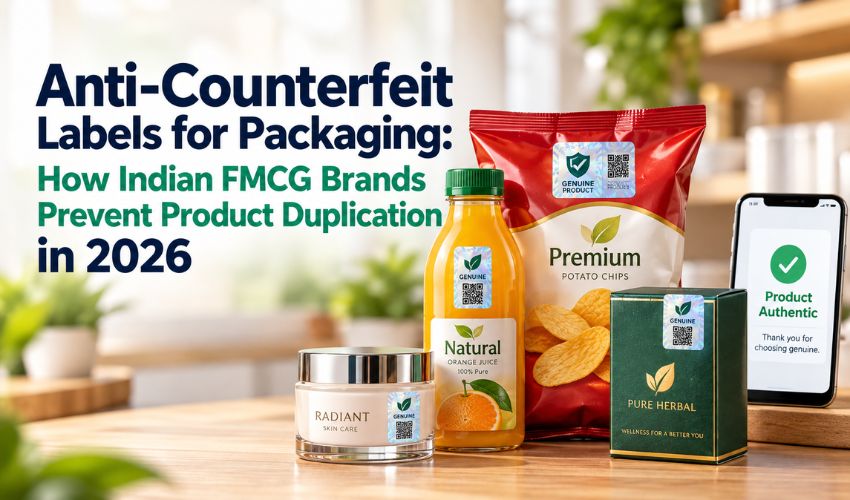
Counterfeit products are no longer limited to a few isolated markets. In India, counterfeit or imitation products can enter the market and supply chain through multiple channels, including unauthorised distributors, grey-market networks, online marketplaces and local retail channels. For FMCG brands, this creates more than a revenue problem. Counterfeit products can damage consumer trust, affect brand reputation and, in certain categories, create direct safety concerns.
This is why anti-counterfeit packaging in India is becoming an important part of modern brand protection. Security labels, holograms, tamper-evident features, QR codes and other authentication technologies can help brands identify genuine products and make duplication more difficult.
However, there is no single security feature that works for every product. The right solution depends on the product category, packaging format, distribution model, risk level and the specific counterfeiting risks the brand faces.
What Are Anti-Counterfeit Labels?
Anti-counterfeit labels are special security labels placed on product packaging to help identify genuine products and make fake products harder to copy.
These labels can include features such as holograms, QR codes, unique numbers, tamper-evident designs and other security elements. Depending on the product, brands may use one feature or combine several features for better protection.
For FMCG brands, these labels can help retailers, distributors and consumers check whether a product is genuine. They can also make it more difficult for counterfeiters to copy the packaging and sell fake products as original ones.
However, there is no single anti-counterfeit solution that works for every product. The right option depends on the product category, packaging type, counterfeit risk and specific business requirements.
How Anti-Counterfeit Labels Work?
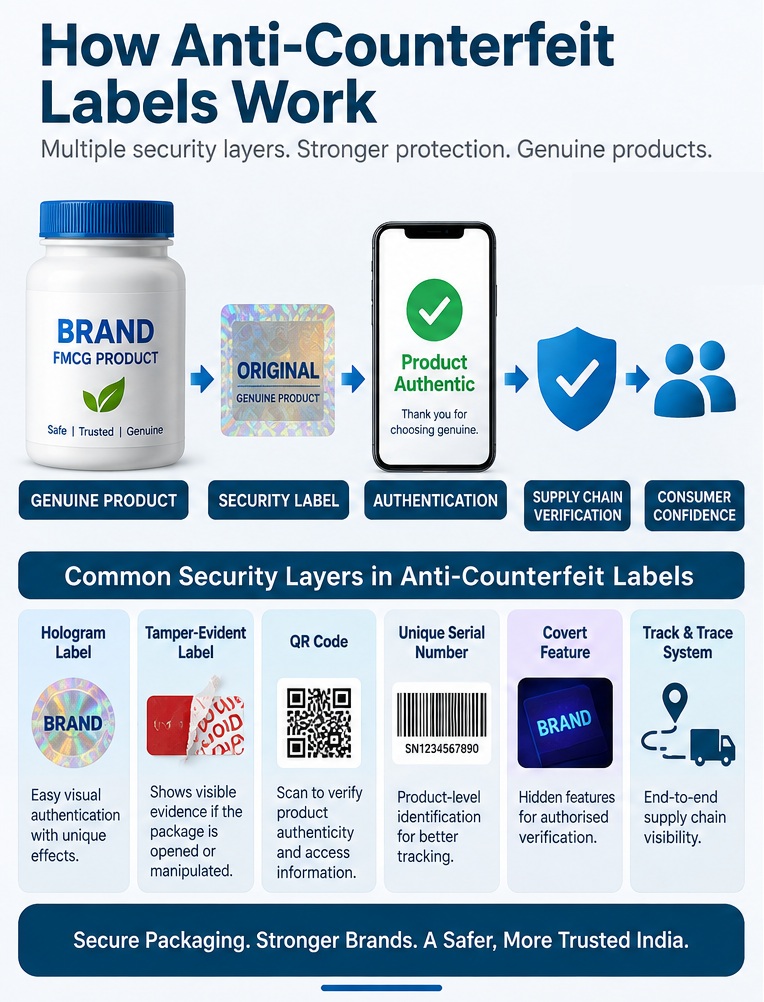
The important point is that these technologies can be combined. A brand may use a visible hologram for quick identification and a unique QR code for digital verification.
Why Does Product Duplication Remain a Challenge in India?
India has a large and diverse consumer market, with products moving through organised retail, traditional retail, wholesalers, distributors and e-commerce platforms. This complexity can create opportunities for counterfeit products to enter legitimate-looking channels.
Counterfeiting can take several forms. Counterfeiters may copy a brand's packaging, reproduce labels, reuse genuine containers or create products that closely resemble the original. In some cases, consumers may not immediately notice the difference.
For FMCG companies, the impact can extend beyond lost sales. If consumers have a poor experience with a counterfeit product, they may associate that experience with the genuine brand.
The issue can be particularly concerning in categories such as pharmaceuticals and personal care, where counterfeit products may contain inappropriate, ineffective or unsafe contents and therefore create potential health or safety risks.
A recent example demonstrates the seriousness of the problem. In September 2026, authorities in Bengaluru uncovered a counterfeit medicine network in which fake cancer medicines and other critical drugs were allegedly repackaged and sold through a distribution network. Reports said the products had been supplied to more than 90 hospitals and clinics.
Fake cancer drugs supplied to more than 90 Bengaluru hospitals, pharmacy owner arrested
This shows why packaging authentication should be considered as part of a broader brand-protection strategy rather than simply a design feature.
How Security Labels Help Combat Counterfeiting
Security labels work by introducing additional barriers between a counterfeit product and the genuine product.
A basic printed label can often be reproduced relatively easily. A specialised security label can combine physical, optical and digital security features that are more difficult to reproduce accurately.
1. Hologram Labels
Holograms can create distinctive optical effects that help consumers and retailers recognise and check genuine packaging. Advanced holographic solutions can incorporate customised designs and multiple security elements.
A survey of Indian FMCG companies reported that 25% of respondents used holograms among their overt anti-counterfeit technologies. This figure reflects the surveyed companies and should not be interpreted as a current industry-wide adoption rate.
2. Tamper-Evident Labels
Tamper-evident labels are designed to show visible evidence when someone attempts to remove, open or manipulate the packaging.
They can be particularly useful where package integrity and detection of attempted tampering are important.
3. QR Codes & Digital Authentication
A unique QR code can connect physical packaging with digital information. Depending on the authentication system, consumers or supply-chain partners can scan the code to access product information, verification or traceability data.
In pharmaceuticals, India's regulatory framework has increasingly incorporated QR/barcode-based authentication and traceability. In June 2026, the Union Health Ministry expanded the Schedule H2 QR-code framework to vaccines, antimicrobials, anti-cancer medicines, and specified narcotic and psychotropic drugs, with phased implementation.
4. Covert Security Features
Covert features are not necessarily visible to ordinary consumers. They can be designed for trained personnel, inspectors, distributors or brand-protection teams.
This adds another layer of authentication because counterfeiters may reproduce visible packaging while failing to replicate hidden security elements. Source: https://www.pib.gov.in/PressReleasePage.aspx?PRID=2277691&hghg=2&lang=1®=48
Industry Use Cases: FMCG, Pharma & Cosmetics
Different industries face different counterfeit risks, so security solutions should be selected according to the product, packaging, distribution model and specific risk.
FMCG
FMCG brands can use security labels on products such as food, beverages, personal care products, household goods and other high-volume consumer products.
A combination of tamper evidence, holographic authentication, unique codes and supply-chain monitoring can help make product duplication more difficult and support product verification.
Pharmaceuticals
Pharmaceutical packaging requires a more controlled approach because counterfeit or substandard medicines can create potential risks to patient safety.
India introduced QR/barcode requirements for the specified top 300 drug formulation brands from 1 August 2023. The framework was expanded in June 2026 to additional categories including vaccines, antimicrobials, anti-cancer medicines and specified narcotic and psychotropic drugs. Source: https://www.pib.gov.in/PressReleasePage.aspx?PRID=2244523&lang=1®=3
Under the expanded framework, the QR code is intended to support authentication and verification across the supply chain and can contain information such as unique product identification, drug name, brand name, manufacturer details, batch number, manufacturing and expiry dates, manufacturing licence number and specified excipient information. Source: https://www.pib.gov.in/PressReleasePage.aspx?PRID=2277691&hghg=2&lang=1®=48
Cosmetics & Personal Care
Cosmetics and personal-care products can also face packaging imitation and unauthorised duplication, particularly where established brands have strong consumer demand.
Depending on their risk profile, brands may consider tamper-evident seals, holographic labels, unique identification codes and digital verification features.
The key takeaway
There is no one-size-fits-all security label. The right combination of overt, covert, tamper-evident, holographic and digital features depends on the product, packaging format, distribution environment and specific counterfeiting risk.
What Technology Is Used in Anti-Counterfeit Packaging?
There is no universal anti-counterfeit solution that is suitable for every FMCG product.
A premium cosmetic product may require a different approach from a mass-market packaged food product. Similarly, pharmaceutical packaging may require regulatory track-and-trace capabilities that are not necessary for a conventional household product.
Common technologies include:
| Technology | Typical Purpose |
| Hologram labels | Visual authentication and brand protection |
| Tamper-evident labels | Detect attempted removal or packaging interference |
| QR codes | Digital verification, identification and information access |
| Unique serialisation | Give individual products or packs a unique identity |
| Covert features | Verification by authorised personnel or trained users |
| Optical variable features | Create dynamic, angle-dependent visual effects that are difficult to reproduce accurately |
| Track-and-trace | Monitor and record product movement through the supply chain |
The final combination depends on factors such as product value, counterfeit risk, packaging material, production volume, consumer behaviour, distribution network and regulatory requirements.
Why I prefer these changes
- “Anti-counterfeit solution” is better than “anti-counterfeit label” because not every technology listed is necessarily a label.
- Tamper-evident → “detect attempted removal or packaging interference” is more precise than simply “detect packaging interference.”
- QR codes should not be presented as inherently authenticating a product. Their verification capability depends on the digital system behind them.
- Unique serialisation is more precise as an identity mechanism rather than simply “identify individual products or batches.”
- Optical variable features → “dynamic, angle-dependent visual effects” fits your OVD/DOVID discussion and avoids the absolute claim that they cannot be copied.
- Track-and-trace is correctly positioned as a supply-chain function rather than a standalone label feature.
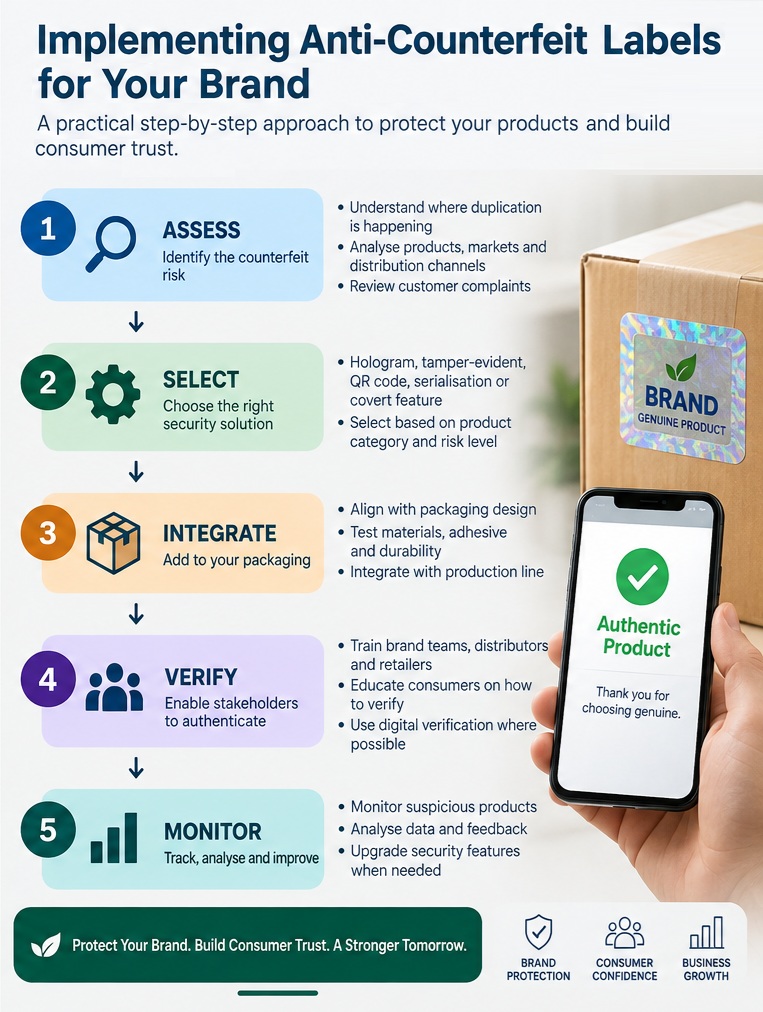
How Brands Can Implement Anti-Counterfeit Labels
Implementing a product protection system should start with a risk assessment rather than immediately selecting a label or security feature.
Step 1: Identify the Counterfeit Risk
Determine where counterfeiting is occurring and which products are most affected. Analyse complaints, distributor feedback, online listings and market investigations.
Step 2: Select the Appropriate Security Level
Decide whether the product needs visible authentication, tamper evidence, digital verification, covert security or a combination of these features.
Step 3: Integrate With Packaging
The security label should work with the existing packaging design and production process. Placement, adhesive, substrate and durability should be tested before large-scale production.
Step 4: Add Digital Authentication Where Required
For suitable products, unique QR codes or serialisation can connect physical packaging with a digital authentication or verification platform.
Step 5: Train Distributors and Retailers
A security label is more useful when the people handling the product know what they should check. Retailers and distributors can be trained to identify genuine security features and report suspicious products.
Step 6: Monitor and Improve
Counterfeiters can change their methods over time. Brands should periodically review the effectiveness of their security system and upgrade features when necessary.
Are Anti-Counterfeit Labels Mandatory in India?
Anti-counterfeit labels are not universally mandatory for every FMCG product in India. The legal requirements depend on the product category and the regulations applicable to it.
For packaged commodities, India's Legal Metrology framework requires specified declarations such as manufacturer/packer/importer information, net quantity, MRP, relevant date information and consumer-care details. These are labelling requirements and should not be confused with a universal requirement to use anti-counterfeit security labels.
Pharmaceutical products are different. Specific categories of medicines are subject to QR/barcode-based authentication and traceability requirements under the Drugs Rules. The 2026 expansion also introduced phased implementation dates for newly covered categories.
Therefore, brands should check the regulations applicable to their specific product category before selecting a compliance or anti-counterfeit solution.
Anti-Counterfeit Packaging Implementation:
Frequently Asked Questions
1. What are anti-counterfeit labels in packaging?
Anti-counterfeit labels are security-enhanced packaging labels designed to help authenticate genuine products, detect tampering and make unauthorised duplication more difficult.
2. How do anti-counterfeit labels protect FMCG brands?
They add authentication and tamper-detection features to packaging. Depending on the solution, they can help consumers, retailers, distributors and brand-protection teams distinguish genuine products from suspected counterfeits.
3. Which technologies are used in anti-counterfeit packaging labels?
Common technologies include holograms, tamper-evident labels, QR codes, serialisation, optical features, covert security elements and track-and-trace systems. The appropriate combination depends on the product, counterfeit risk and supply-chain requirements.
4. Are anti-counterfeit labels mandatory in India?
Not for every FMCG product. Requirements vary by product category. Certain pharmaceutical products are subject to specific QR/barcode authentication and traceability requirements under India's Drugs Rules, while general packaged commodities have separate labelling requirements under Legal Metrology rules.
Final Thoughts
In 2026, anti-counterfeit packaging is an increasingly relevant part of brand protection in India. For FMCG companies, the objective should not simply be to add a hologram or QR code to packaging. A more effective approach is to build a layered authentication system based on the product category, counterfeit risk and supply-chain requirements.
From hologram labels and tamper-evident solutions to smart labels, QR-based verification and track-and-trace technology, brands have multiple options. The right combination can make product duplication more difficult while giving consumers and supply-chain partners greater confidence in product authenticity.
For Indian brands dealing with counterfeit products, selecting the right security solution can become an important part of protecting both the product and the trust built around the brand.
Latest Blogs
Anti-Counterfeit Labels for Packaging: How Indian FMCG Brands Prevent Product Duplication in 2026
Sep 28, 2026
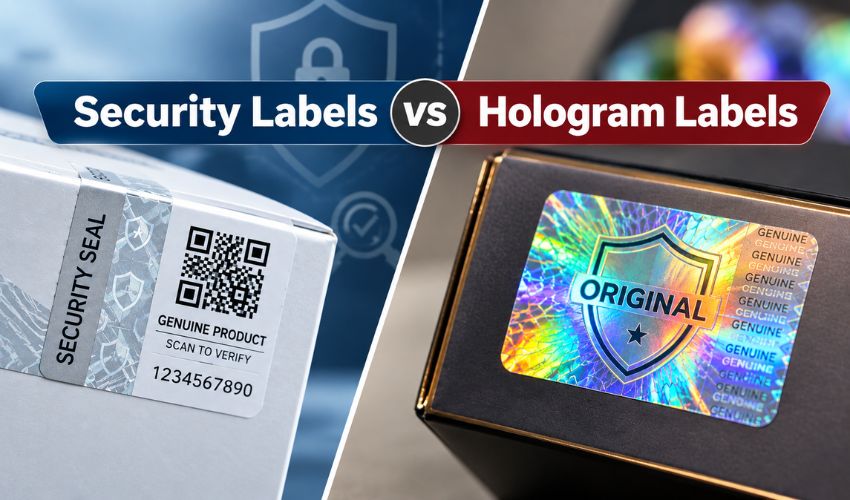
Security Labels vs Hologram Labels: Which Anti-Counterfeit Solution Is Best for Indian Manufacturers?
Sep 18, 2026
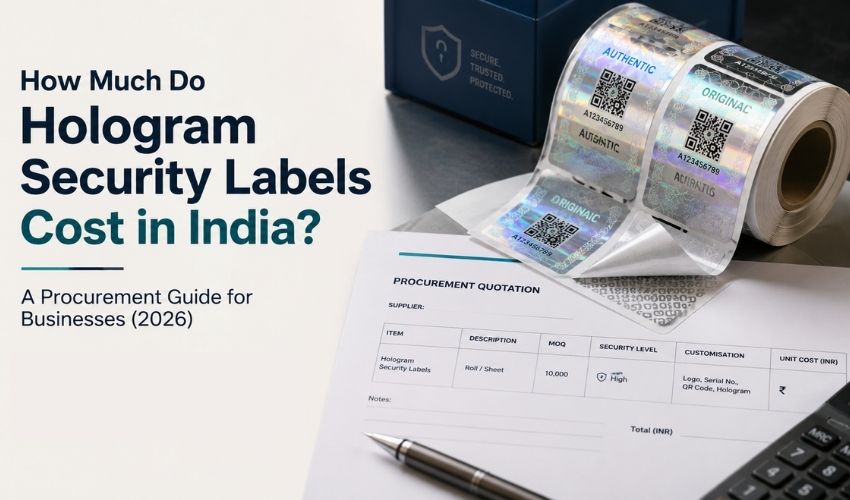
How Much Do Hologram Security Labels Cost in India? A Procurement Guide for Businesses (2026)
Aug 21, 2026
Garment Tags in India: How Brands Use Custom Tags to Increase Perceived Value & Sales
Jul 27, 2026
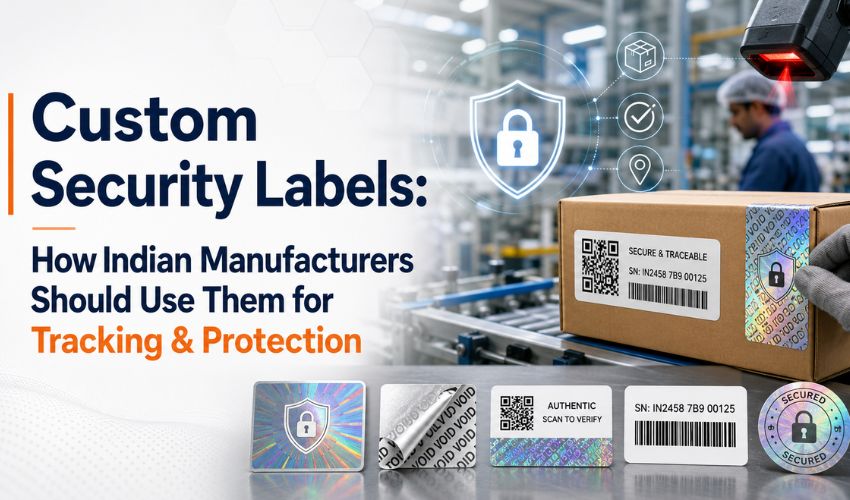
Custom Security Labels: How Indian Manufacturers Should Use Them for Tracking & Protection
Jul 16, 2026
Top Benefits of Shrink Sleeve Labels for Product Packaging
Jun 29, 2026
Security Labels for Automotive Parts Manufacturers
Jun 23, 2026

The Evolution of Holographic Technology: From Visual Authentication to Advanced Optical Security
Jun 10, 2026
Smart Labelling Solutions For Food & Beverage Packaging
May 25, 2026
How Secure Packaging Helps E-Commerce Brands Reduce Fraud?
May 21, 2026

How Security Holograms Prevent Counterfeit Pharmaceuticals in India
Jul 16, 2025
Top 5 Custom Hologram Applications for FMCG Packaging
Jul 24, 2025
How Security Holograms Shield FMCG Packaging from the Rising Counterfeit Menace
Aug 16, 2025
Why Self-Adhesive Labels Are the Smarter Choice for Modern Packaging
Aug 21, 2025

Revolutionizing Brand Protection: Holographic Security Packaging with Integrated Phygital Solutions
Oct 23, 2025
Protecting Your Brand with Tamper-Evident Labels in India
Oct 30, 2025
OVDs vs Traditional Holograms: What Modern Brands Should Choose in 2026
Dec 19, 2025
Eco-Friendly Label Materials: How Brands Can Reduce Packaging Waste Without Losing Security
Jan 06, 2026
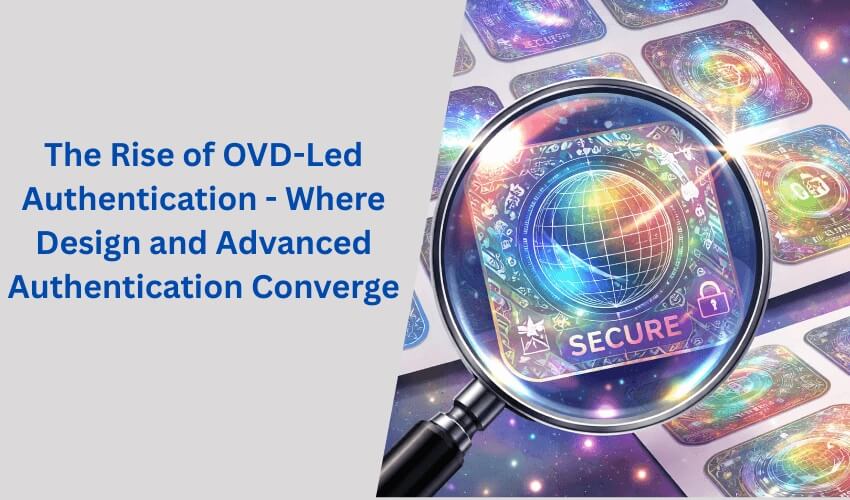
The Rise of OVD-Led Authentication - Where Design and Advanced Authentication Converge
Feb 12, 2026
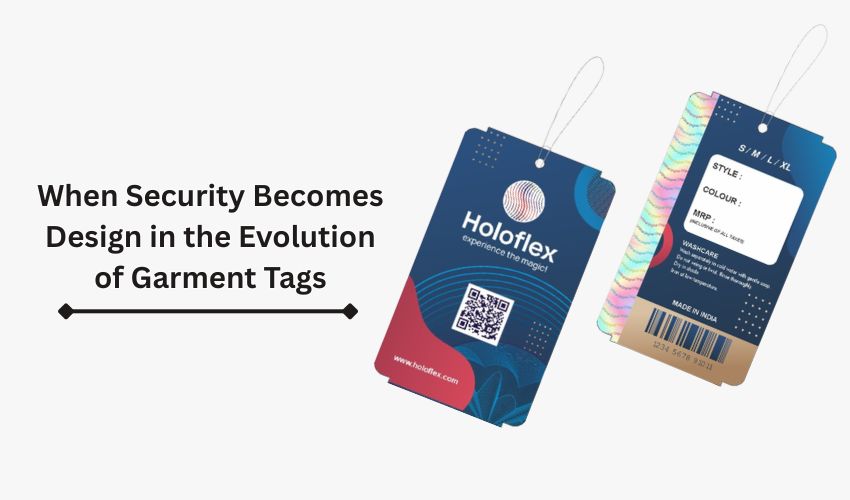
When Security Becomes Design in the Evolution of Garment Tags?
Feb 24, 2026
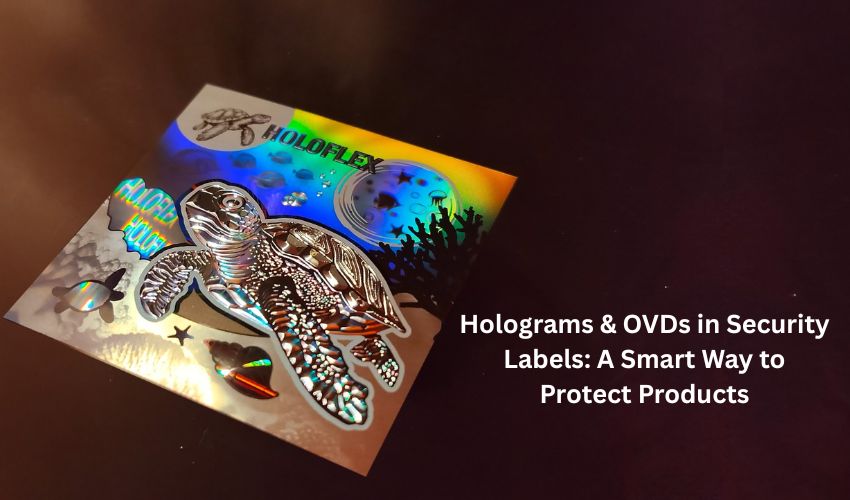
Holograms & OVDs in Security Labels and Stickers: A Smart Way to Protect Products
Mar 17, 2026
Customised Packaging Labels in India: A Complete Guide for Businesses
Mar 24, 2026
How Advanced OVD Technology is Transforming Hologram Security in 2026?
Apr 28, 2026